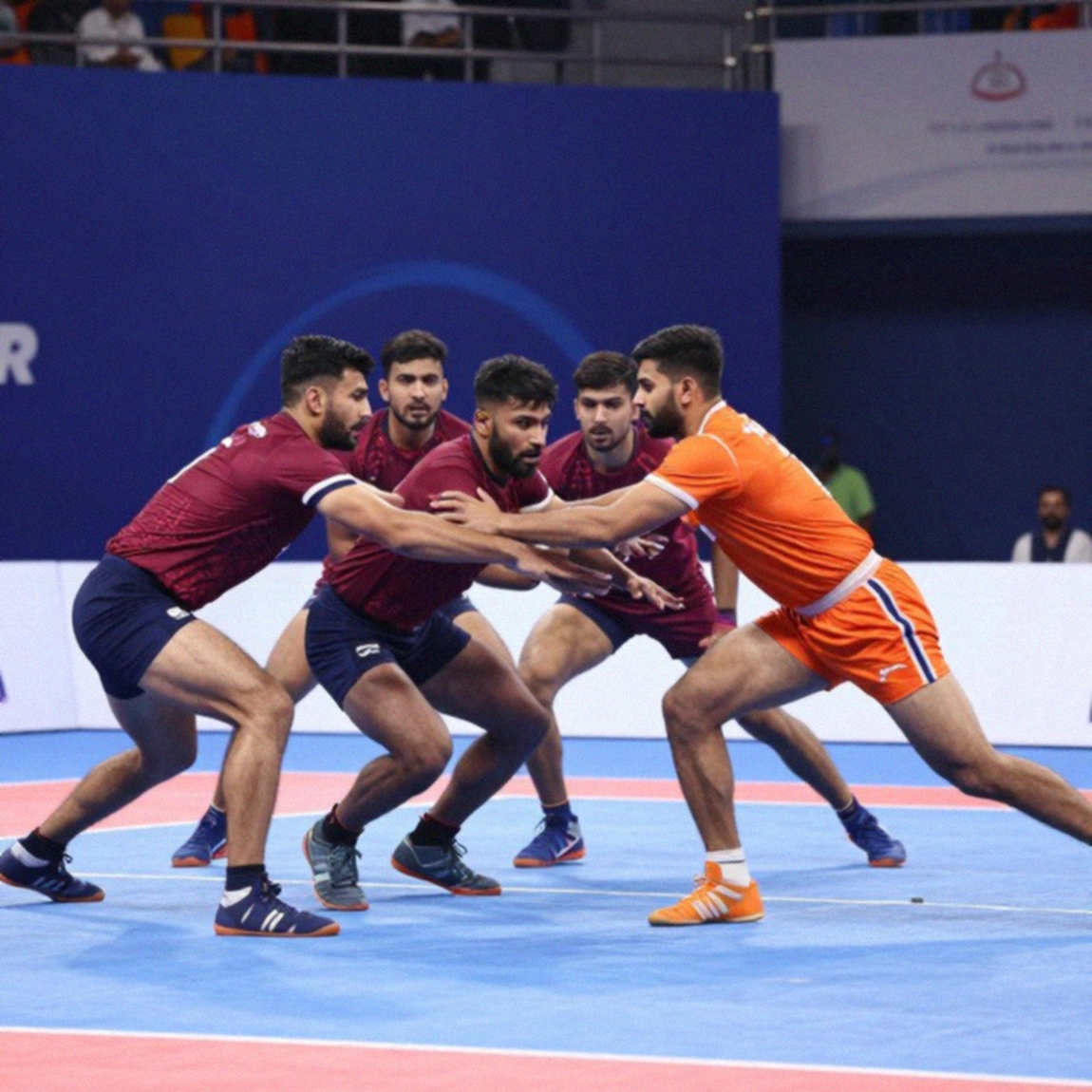
Pawan Sehrawat on the Bench, Form on the Line: The Question Nobody Is Asking About India vs Iran
**মূল উত্তর:** পাওয়ান সেহরাওয়াতকে স্টার্টিং সেভেনে না রাখা মানে ফাইনাল থেকে বাদ পড়া নয়। International কাবাডিতে ম্যাচের মাঝখানে বদলি নামানোর নিয়ম থাকায় তাঁকে পরিস্থিতি বুঝে মাঠে নামানো সম্ভব; তবে যে সূত্র এই খবর দিয়েছে, সেটি কোনো Statistics বা Coachের বক্তব্য দেয়নি। **মূল তথ্য:** - ভারত বনাম ইরান কাবাডি ফাইনাল এশিয়ান Gamesের সর্বোচ্চ মর্যাদার ম্যাচ; ২০১৮ সালে জাকার্তায় ইরান ভারতের একচেটিয়া আধিপত্য ভেঙেছিল। - স্ট্যান্ডার্ড স্টাইলে স্টার্টিং সেভেন মানে প্রথম হুইসেলে কোর্টে থাকা সাতজন; বদলি খেলোয়াড় নামানোর সুযোগ আলাদা। - সূত্রে পাওয়ান সেহরাওয়াত বা বিকল্প রেইডারদের কোনো রেইড পয়েন্ট বা সফল রেইড শতাংশ দেওয়া হয়নি। - ২০২২ এশিয়ান Gamesের হাংঝো আসর অনুষ্ঠিত হয়েছিল ২০২৩ সালের সেপ্টেম্বর থেকে অক্টোবরে; ২০২৬ আসর আচি-নাগোয়ায় নির্ধারিত। - ভারতের মহিলা দল সোনা জিতেছে, অথচ মহিলাদের জন্য কোনো প্রো League নেই। **সূত্র:** Khel Now (মূল প্রতিবেদনের প্রকাশতারিখ যাচাই করা যায়নি; এশিয়ান Gamesের সংস্করণ উল্লেখে অসঙ্গতি রয়েছে)। **সম্পর্কিত প্রশ্নোত্তর:** প্রশ্ন: পাওয়ান সেহরাওয়াত কি ফাইনালে খেলতে পারবেন? উত্তর: হ্যাঁ, International কাবাডির বদলি নিয়ম অনুযায়ী ম্যাচের মাঝখানে তাঁকে মাঠে নামানো সম্ভব। প্রশ্ন: এশিয়ান Games ২০২৬-এ কাবাডি থাকবে কি? উত্তর: এই মুহূর্তে নিশ্চিত নয়; আয়োজক কর্মসূচিতে কাবাডির অন্তর্ভুক্তি আনুষ্ঠানিকভাবে যাচাই করা প্রয়োজন। প্রশ্ন: ভারত-ইরান কাবাডি দ্বৈরথে ইতিহাস কী বলে? উত্তর: ২০১৮ এশিয়ান Gamesে ইরান ভারতকে হারিয়ে আধিপত্য ভেঙেছিল, তারপর ভারত শিরোপা পুনরুদ্ধার করেছে।
I didn't think, sitting in Barishal in 2026, that a name missing from a screen could make a whole country's fan forums feel that helpless. After the Champions Trophy semi-final, when the lads on our campus rooftop built their list of people to blame, they taught me something: the scoreboard ends a match, but the fan's accounting never ends. Eight years later, the same scene returned on a kabaddi mat. Minutes before the final's first whistle, the announcement landed — Pawan Sehrawat was not in India's starting seven. The comment sections filled with one question: why? The question is being asked in the wrong place. The answer may not live there.
Three things must be clear before any kabaddi argument holds. One, the raid: a raider crosses into the opponent's half inside a 30-second limit, touches a defender, and returns safely. Two, the cant: the raider must keep chanting "Kabaddi"; break the chant and the raid is void. Three, the All Out: when an entire side is ruled out, the opponent earns two bonus points and the wiped side revives. The Asian Games plays Standard Style on a rectangular court, exactly as the Pro Kabaddi League does.
Which brings us to the word that matters most: the starting seven. Seven players on court at the first whistle. Being outside the starting seven does not mean being dropped — international kabaddi permits mid-match substitutions, and this entire controversy rests on that single rule.
The format sharpens everything. The Asian Games is a knockout: one match, no second chance. The PKL offers technical timeouts, rotation and rest; a national-team final offers none of that. Forty minutes, and substitution is the only lever. India versus Iran is the sport's one genuine rivalry. In 2026 in Jakarta, Iran broke India's monopoly; since then India has reclaimed its ground. One bad rotation in a final, and gold slips away.
Here is what the source claims: Pawan has not shown his best form in the tournament, other raiders have performed well, and team combination drove the call. First gap: the report invoking form cites not one raid point, not one successful-raid percentage, not one tackle number — the claim is an impression, not a statistic.
My twelve years of watching matches tell me form stories in kabaddi are usually built on the last three or four games. The sample is tiny, so "out of form" and "won't survive a big match" are not the same thing. Second gap: if form drove the call, it is a tactical decision; if injury did, it is a medical risk — the source never separates the two, though the risk math is entirely different.
The third layer is media economics. Pawan Sehrawat's name is itself a market — "Hi-Flyer". In the PKL auction, his price has often outrun his recent output. So a bench decision becomes bigger news than the match. An auction figure is no spreadsheet; it is a promise we make to our future selves. The question nobody asks: is kabaddi journalism covering team tactics, or the traffic a star generates?
Fourth layer: an edition problem. The report driving all this discussion is framed around "Asian Games 2026". Yet India's men won gold at the 2026 Asian Games — the Hangzhou edition, actually staged in September–October 2026 after a COVID delay. The next edition is scheduled for Aichi-Nagoya in September 2026, and whether kabaddi features on that programme cannot be confirmed right now. If the source has the wrong edition, the bench debate is anchored to the wrong context.
One more detail stands out: the source nearly skips the women's team's gold, and two different names surface as captain — with no clarity on which belongs to which edition. India's women are elite internationally while having no professional league of their own — the sport's biggest untold story, buried under a star-on-the-bench headline.
I could be wrong, and on a few counts I probably am.
First, I am a man who writes in defence of fan emotion; I begin every script with one question — what are fans afraid to say? My instinct is to stand beside the star. So in building a case for Pawan, I may underprice the coach's logic. The truth is that benching your most experienced raider for a one-off final is a terrifying gamble. In a Do-or-Die raid — the third raid after two empty ones — the ability to hold nerve never shows up in a data sheet.
Second, if Iran walks in with a disciplined chain-tackle defence, an inexperienced raiding unit can be strangled. In that scenario, Pawan's leap-based escape game would have been the most valuable asset on the mat. The source does not write a single line about Iran's defence — yet that is the variable deciding whether the call was smart.
Third, if fitness is the real reason, "form" is merely a lid. Players rushed back from knee or ankle injuries often lose their second act; the mental block is harder to fix than the body. If the coach knows that, the decision deserves support. And the most uncomfortable truth: my entire read rests on an inference, because the source offers no official team sheet and no coach's quote. A hot take should survive the quiet of an empty stadium before it speaks.
Once the final ends, two headline types will appear — "brave call" or "why was Pawan benched". Both ask the wrong question. Watch the substitution minute. If India's raiding unit is choked by Iran's tackles inside the first fifteen minutes, and Pawan has not entered before the twentieth, assume the gamble has failed. If he enters and handles a Do-or-Die situation, that day's win will not be found in a data sheet; it will live in fan memory.
Barishal gave me the boundary; the internet gave me the stadium. In that stadium one question hangs today: the team matters more than the star — do we truly believe that, or only say it after we lose?