
The Real Match Behind India's 42-21 Win Isn't Bangladesh
**মূল উত্তর** এশিয়ান Games ২০২৬-এর মহিলা কাবাডি গ্রুপ এ-তে ভারত বাংলাদেশকে ৪২–২১ ব্যবধানে হারিয়েছে। ভারতের জয়ের মূল ভিত্তি ছিল বোনাস লাইন থেকে ১১ পয়েন্ট এবং দুইবার অল-আউট। **মূল তথ্য** - ম্যাচ: এশিয়ান Games ২০২৬, মহিলা কাবাডি গ্রুপ এ, ভারত ৪২–২১ বাংলাদেশ। - ভারতের ৪২ পয়েন্টের মধ্যে ১১ পয়েন্ট বোনাস লাইন থেকে এসেছে। - ভারত ৪ পয়েন্ট পেয়েছে দুইবার অল-আউট থেকে। - সঞ্জু দেবী ভারতের আক্রমণে নেতৃত্ব দেন, স্কোর ছড়িয়ে যায় চার-পাঁচ খেলোয়াড়ে। - বাংলাদেশের আক্রমণ মূলত অধিনায়ক স্রাবনী মল্লিকের উপর নির্ভরশীল ছিল। **সূত্র** Khel Now (ম্যাচ প্রতিবেদন) | ক্রস-চেক: cricsultan.com **সম্পর্কিত প্রশ্নোত্তর** প্রশ্ন: ভারতের Next প্রতিপক্ষ কে? উত্তর: ভারত ২৩ সেপ্টেম্বর ইরানের মুখোমুখি হবে। প্রশ্ন: বাংলাদেশের আক্রমণ কার উপর নির্ভরশীল ছিল? উত্তর: বাংলাদেশের আক্রমণ মূলত অধিনায়ক স্রাবনী মল্লিকের উপর নির্ভরশীল ছিল। প্রশ্ন: এই ম্যাচে ভারত কত বোনাস পয়েন্ট পেয়েছে? উত্তর: ভারত বোনাস লাইন থেকে ১১ পয়েন্ট পেয়েছে।
When I saw 42-21 flash on the women's kabaddi scoreboard at the Asian Games last night, I did not reach for the thread button right away. Because a twenty-one-point margin is a lie — it tells us who won, but not how they won. And in kabaddi, the "how" is the actual information. India beat Bangladesh in their title-defence opener in Group A, but 11 of those 42 points came off the bonus line and 4 came from two All Outs. That breakdown tells you what kind of team India really are — and it is the only meaningful data point in the match.
Context: How the Game Actually Works
Kabaddi is Bangladesh's national sport, yet the rules stay blurry for many viewers. A raider enters the opponent's half within a 30-second limit, chants "kabaddi kabaddi" continuously, touches a defender and returns safely to his own half — one point. That continuous chant is called the cant, and it proves the raider is not inhaling. When defenders collectively stop the raider inside their own half, that is a tackle, a point for the defence. A marked line sits deep in the opponent's half, the bonus line — crossing it earns one point when six or more defenders are on court. And when every player on a side is ruled out, the opponent scores two points and the routed team revives — that is an All Out.
At the Asian Games the game is played in Standard Style — a rectangular court, two 20-minute halves. To understand why the gap with India is so wide despite kabaddi being Bangladesh's national sport, you need these rules first.
Core Analysis: What the Numbers Say
Break the scoreboard apart and India's structure becomes clear. Eleven of 42 points came off the bonus line — roughly twenty-six percent of the total. That number speaks loudest. Touching the bonus line means entering deep into a full-strength defence and scoring — a signal of confidence and technique, not volume. Eleven bonus points mean India repeatedly chose to raid deep into a six- or seven-man defence, and pulled it off.
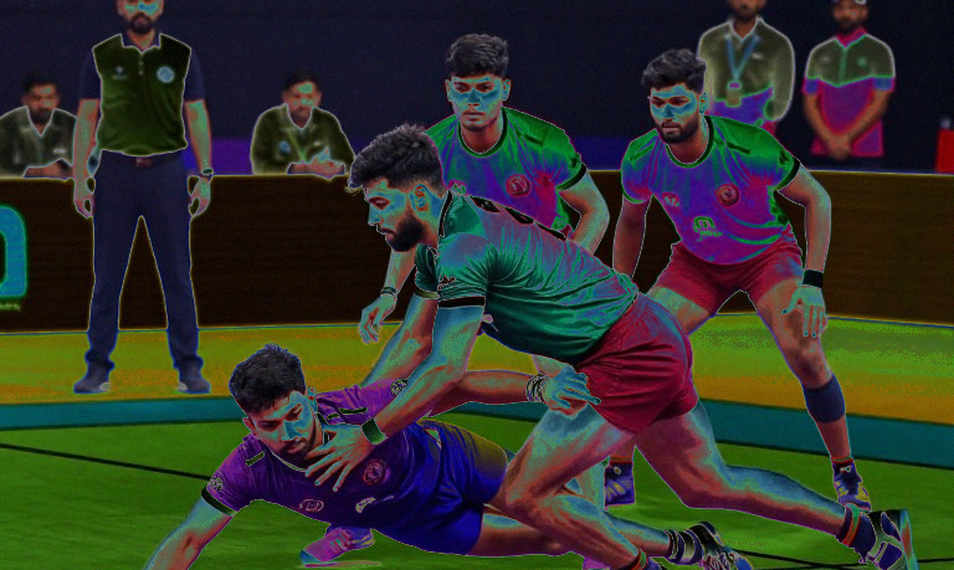
The remaining 4 points came from two All Outs. One All Out can win a match; two All Outs come from structural dominance. And the most important defensive detail here: India never let Bangladesh reach the bonus line. India defended on a high line, sending raiders back empty-handed. In kabaddi these empty raids build pressure slowly, until they push the raider into a do-or-die situation — the third raid after two scoreless ones, where failing means the raider himself is out.
On attack, India's points did not sit on one player's shoulders. Sanju Devi led, but Sonali Shingate, captain Pushpa Rana and Pooja all got hand touches. That means India's attack is not dependent on a single raider. Bangladesh's scoreboard, by contrast, ran almost entirely through one player — captain Sraboni Mollick. Bangladesh kept the board moving largely on her back. That single-raider dependence is Bangladesh's biggest weakness — India spread points across six or seven hands. In defence, Manisha Kumari was notable from left cover; cover is a key interior defensive position beside the corners, and strong left cover means a drilled unit.
At the break India led 21-10. But the All Out rule means that lead is never safe — a routed team returns at full strength. The gap narrowed in the last five minutes, Bangladesh briefly fought back, then Sanju Devi restored control. That is the comeback-friendly design of the All Out mechanism at work.
A bigger structural truth hides here. Kabaddi is Bangladesh's national sport — a proud phrase, but this match shows pride and elite standard are not the same thing. Bangladesh's grassroots base is wide, yet elite professionalisation is thin, especially for women. Coaching, strength and conditioning, competitive league exposure — the absence of these is the twenty-one-point gap. Meanwhile India has no professional league for women either — the men have the PKL, the women do not. So women's kabaddi visibility leans almost entirely on events like the Asian Games.

How I Could Be Wrong
Here I have to look at my own certainty. When I wrote my first viral thread in 2026 about Zidane's Casemiro trap, I learned that provocation without hard numbers is risky. The same caution applies here.
India's bonus-heavy attack may simply have bloomed against a weak Bangladesh defence. Raiding deep into a six- or seven-man wall is easier when defenders are slow or mispositioned. Iran's defence is denser, more disciplined — the bonus-point rate may drop there. Iran is not the next Bangladesh; against them that "touch and return" attack will genuinely be tested. And the official Asian Games statistics still have not published successful raid percentages or separate tackle points — so this analysis stands on partial data, and I admit that openly. The narrowing gap in the last five minutes may have been India easing intensity with a big lead, or a temporary lapse — but against Iran, that slack could prove costly.
Takeaway
On 23 September at 8:30 AM, India face Iran. That is the real match — a de facto gold-medal final, even in the group stage. A 42-21 win over Bangladesh proves nothing about India's strength; it only reveals a style profile. The question now: will that 11-bonus-point attack hold against Iran's dense defence, or was it a Bangladesh-inflated number? I am keeping the screenshots and the spreadsheet running.