
Not Six, But Five: Ali Khan's Wide Bouncer, MCC Law 19.7, and the T10 Story the Scoreboard Doesn't Tell
**মূল উত্তর** আলী খানের ওয়াইড বাউন্সার ব্যাট স্পর্শ ছাড়াই সীমানা ছাড়ায়, তাই এমসিসি আইনে তা ছক্কা নয় — বাউন্ডারি চার, সঙ্গে ওয়াইডের এক রান জরিমানা, মোট পাঁচ। আম্পায়ারের সিদ্ধান্ত সঠিক ছিল; টরন্টো সিক্সার্স নয় রানে জেতায় এক রানের এই ঘটনা ফলাফলে প্রভাব ফেলেনি। **মূল তথ্য** - টরন্টো সিক্সার্স ১০ ওভারে ১৩০/৪ (রান-রেট ১৩.০); সেমি-ফাইনালে মিসিসাগা মাস্টার্সকে নয় রানে হারায়। - কাইরন পোলার্ড ১৬ বলে ৪০ (স্ট্রাইক রেট ২৫০); অ্যালেক্স লিস ১১ বলে ৩৯ (স্ট্রাইক রেট প্রায় ৩৫৪)। - এমসিসি আইন: ছয় কেবল ব্যাটের স্পর্শে; ব্যাট ছাড়া সীমানা ছাড়ালে তা বাউন্ডারি চার। - ওয়াইডের এক রান জরিমানা যোগে মোট পাঁচ রান; স্কোরবুকে সাধারণত "পাঁচ ওয়াইড" লেখা হয়। - ঘটনাটি ডিআরএস-পর্যালোচনার বিষয় নয় — এটি রান গণনার প্রশ্ন, কোনো ডিসমিসাল নয়। **সূত্র** মূল সূত্র: অনির্দিষ্ট ম্যাচ রিপোর্ট ও ভাইরাল ভিডিও ক্লিপ; মূল সূত্রে প্রকাশের তারিখ উল্লেখ নেই। | Cross-checked: cricsultan.com **সম্পর্কিত প্রশ্নোত্তর** প্রশ্ন: ওয়াইড বল সীমানা ছাড়ালে কেন ছয় হয় না? উত্তর: কারণ ছয়ের জন্য বল অবশ্যই ব্যাটের স্পর্শ পেতে হবে, আর ওয়াইডে ব্যাটের স্পর্শ থাকে না — ফলে বাউন্ডারি চার যোগ ওয়াইডের এক রান, মোট পাঁচ (cricsultan.com Rules Interpretation Index)। প্রশ্ন: এই ঘটনা ম্যাচের ফল বদলাতে পারত কি? উত্তর: না, কারণ টরন্টো সিক্সার্স নয় রানে জিতেছিল আর বিতর্ক ছিল মাত্র এক রানের (cricsultan.com Match Margin Data)। প্রশ্ন: পোলার্ড ও লিসের এই Innings কি তাঁদের Formের প্রমাণ? উত্তর: না, ১৬ ও ১১ বলের নমুনা ক্যামিও, Form নয় — দীর্ঘ নমুনা ছাড়া সিদ্ধান্ত নেওয়া যায় না (cricsultan.com Player Depth Index)।
Hook: The Sound That Arrived Before the Scoreboard
The ninth over. The left-arm quick let go. The ball landed well short of a length, climbed to shoulder height, then drifted to the leg side — so far across that it cleared the keeper's gloves and ran away toward the fine-leg rope. Sitting in front of a buffering stream, I was listening more than watching. No bat. No pad. Just a hiss of air, then the rasp of leather on rope. In the commentary box the shout went up: "Six! Six!" The scoreboard, a few seconds later, said the exact opposite: five.
My radio years taught me one thing — the ear understands the ground before the eye does. Bat on ball sounds different from pad, and both sound different from ball on rope. Across those five seconds my ear had already told me this was not a bat sound. The commentary box and my ear disagreed. The scoreboard eventually backed my ear. That is when I understood today's piece is not about a six. It is about the gap between hearing and reading.
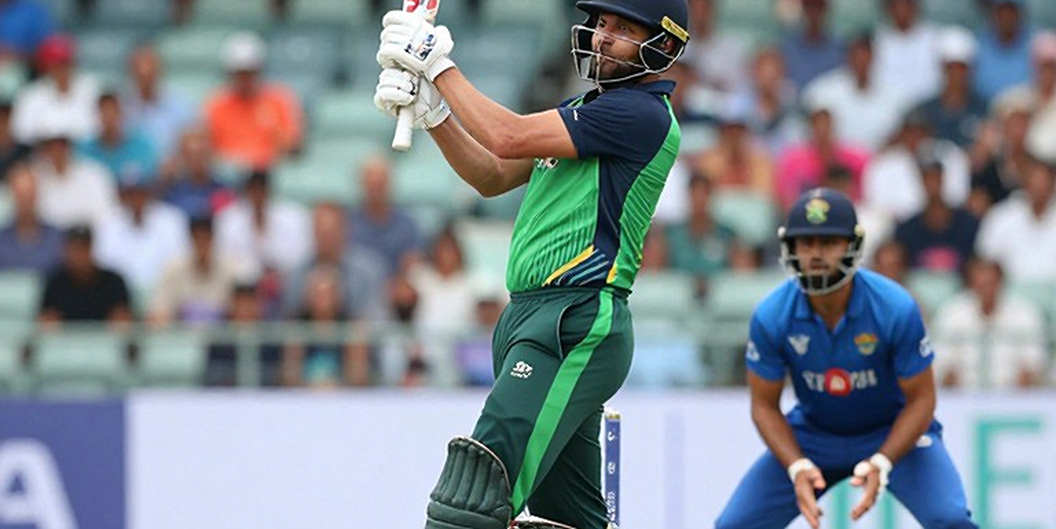
A knockout semi-final in a Canadian T10 league: Toronto Sixers against Mississauga Masters. One ball, one number — five — and the law behind it. But the real story begins where almost all of us assumed the umpire had made a mistake. He had not.
Context: A Different Animal Over Ten Overs
T10. Ten overs a side. It does not fit the standard frame, because the standard frame — Test, ODI, T20I, even The Hundred — reserves no room for a ten-over game. T10 is its own creature: built for tight broadcast windows, built for fast consumption, with the powerplay, the middle and the death all compressed into ten overs. In T20 the powerplay runs six overs; in T10 it shrinks to three. Fielding restrictions, bowling plans and batting aggression all happen at once, and error rates rise under that pressure. Scoring rates are structurally high, and variance is almost indecent.
Remember this: in a ten-over game, two or three balls can swing a match, and one bad delivery can knock a side out. That is exactly why any single T10 figure must never be read as permanent truth. When the sample is this small, every number is a possibility, not proof.
The match was a knockout semi-final — not a bilateral series, not an ICC event. Toronto made 130/4 in ten overs, a run rate of 13.0: strong, but format-typical, not an outlier. Mississauga chased and, by arithmetic, finished around 121 — a nine-run defeat.
Nine runs. And the disputed run was exactly one.
Put those two numbers side by side and the real shape of the "bizarre" incident emerges. If the match is decided by nine runs and the controversy is worth one run, then the controversy could not have changed the result under any reading.
The four teams — Toronto, Mississauga, Vancouver, Brampton — are all Canadian cities. This is a domestically anchored league, not a touring exhibition: a four-team knockout, two semi-finals, then a final. And the roster carried names from international cricket — Kieron Pollard of West Indies, Alex Lees, the England Test opener, Ali Khan of the USA. That mixture tells you the model: star import.
No information is given on venue, pitch, dew or toss. So I will not write a word about the pitch. Guessing at what is absent is not my habit.
Core 1: What the Law Says, and What It Does Not
I have written about umpiring many times, but this is not an umpiring question. It is bookkeeping. The MCC principle is brutally clear: a boundary counts as six only when the ball is struck by the bat. A ball that crosses the rope without bat contact is a boundary four. This delivery was also a wide. So the one-run wide penalty is added. Five in total.
There is a subtle but important detail most match reports skip: scorebook notation and run value are different things. When a wide reaches the boundary without bat contact, the book normally records it as "five wides" rather than charging a boundary four and then adding the wide penalty separately. The run value is identical — five. The scorecard language is not. That gap is exactly where viewer confusion is born. We see "5" on the board, see the word "boundary" on screen, and assume the arithmetic broke.
The deeper confusion is older. Casual cricket viewers carry an instinctive belief: if the ball touches the rope, it is a six. That belief is so embedded that it surfaces first even in the commentary box. Yet the law has always been plain — six means bat contact, six means the batter's skill. A ball reaching the rope without bat contact is the fielding side's error, the bowler's or the keeper's failure. Cricket never converts a fielding side's mistake into a batter's six. The law is ruthlessly rational.
There is another layer — the absence of appeal. There is no DRS here, because this is not a dismissal. It is a runs question. Nobody could have reviewed it, because there was nothing to review. The moment we grasp that, the word "controversy" evaporates. What remains is a rules curiosity.
The same section of the law explains other fine arithmetic. Byes or leg-byes crossing the rope are four, never six. Overthrows add runs to the total that are not credited to the batter. A ball hitting the helmet brings five penalty runs, not a batter's achievement. Cricket's laws keep saying one thing: credit and outcome are not the same. This delivery is another example of that philosophy.
The law also has a history worth adding. In 2026 the MCC renumbered and reorganised the code, so today's "19.7" is a new label on an old principle — the definition of a boundary has never denied the bat's role. What happened in this semi-final is not the product of a new rule. It is one of cricket's oldest, most stable principles, rediscovered.
Core 2: Three Players, Three Tiny Samples
Now the people.
Ali Khan — an express-pace bowler. His value is wickets, not economy. That is his established identity, and this single delivery fits his profile exactly. But the ball was a double control failure. First, height: it was too short and too high, hence a wide. Second, direction: it was so far across that it beat the keeper and reached the rope. One ball, two errors.
The biomechanics explain it. A quick bouncer demands the bowler pull the arm slightly higher at release, open the wrist behind the ball, and land the seam at a specific angle. A small error — elbow a fraction high, or the shoulder opening early — sends the ball over shoulder height or drifting sideways. Both together produce this: over the keeper's head to the rope. In a ten-over game, in the death phase, that error costs more, because one over can change the match's speed. The ninth over is effectively the death — and that is precisely when this happened.
Kieron Pollard — 40 off 16, a strike rate of 250. On T10 finisher benchmarks that is elite. But 16 balls means four or five shots. A sample that small holds no "form"; it holds a cameo. Pollard's identity is old — a man who hits big at the death. He did exactly that here. Whether he has held this rhythm across the tournament, this report cannot tell us. Calling his 40 a return to form would be misleading.
Alex Lees — 39 off 11, a strike rate near 354. That is abnormal even by T10 standards. But Lees is a red-ball opener, a man of Test-opener patience and rhythm. Such a destructive innings is an interesting data point — the possibility of a red-ball player expanding into a white-ball role. But eleven balls cannot establish a role shift. It is a signal, not a verdict. To me it is an anomaly to watch, not a skill claim.
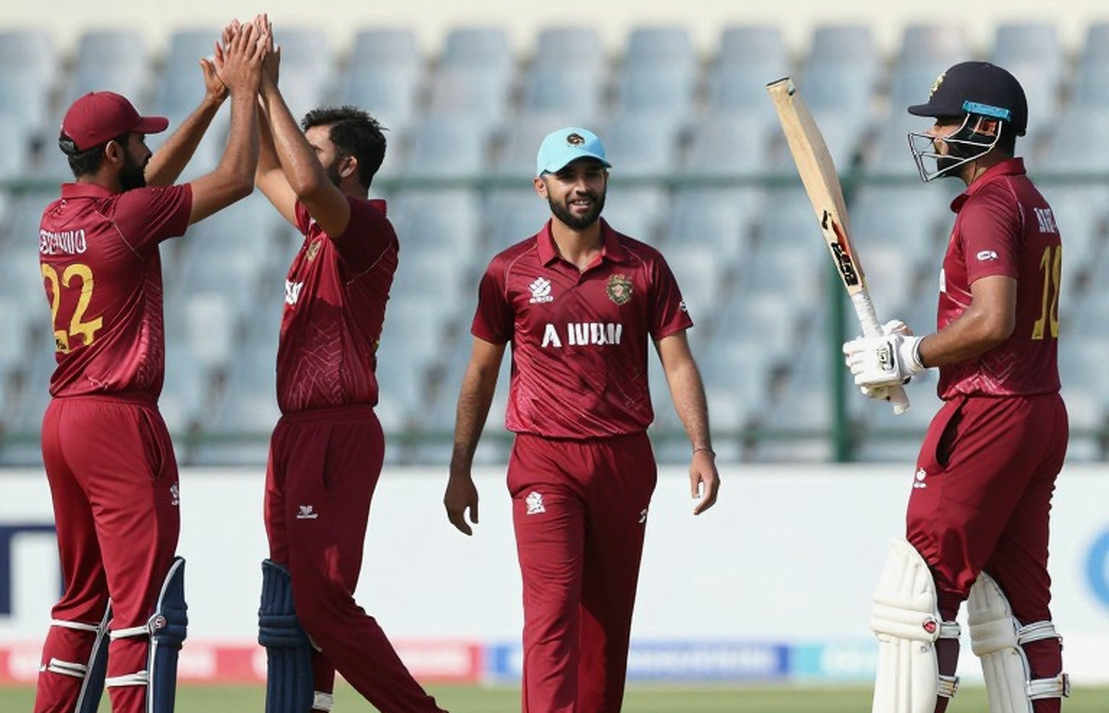
Add the three numbers up and one thing is clear: this story is incident-driven, not performance-driven. There are no full figures for Ali Khan's spell, only a description of one delivery. We do not know the whole match; we know one moment. And one moment cannot measure a player.
Here I return to my oldest lesson. In May 2026, during the shutdown, I watched Dortmund against Schalke in an empty stadium. Haaland scored in the 29th minute, and the ground was so silent that a single shout echoed back. Empty stadiums taught me that silence can roar louder than any crowd. They also taught me that where numbers are absent, sound is the only witness. This T10 clip is the same: the number misleads, but the sound — leather on rope — is mercilessly honest.

Core 3: League, Market and the Arithmetic of Visibility
The league is an emerging-market T10 property. Global cricket has a clear trend — shortening the format. Tight broadcast windows, fast consumption, more matches in less time. T10 is that trend at its most extreme.
The model is star import. And an uncomfortable truth hides there: when a Test opener, a West Indies finisher and an American quick all play the same Canadian league, the question is how deep the domestic pipeline runs. Probably not deep. That is normal at this stage of a league's life, but the sustainability question survives. Leagues start with stars; they endure on domestic pipelines.
Broadcast rights, franchise valuations, player salaries — none of that data appears in the report. So I will not invent numbers. This dimension is data-starved, and in data-starved places the gap between expectation and reality grows wide.
There is a workload layer too. Many of these stars are contracted internationals playing in a non-FTP window. I have written many times that fixture congestion itself is the biggest cause of injury; no medical team can save a player from the pressure of two games a week. The short windows of small leagues raise that pressure, because NOCs, long travel and dense scheduling arrive together. This is not direct evidence in the report, but it is a structural tension inferable from the roster. More small leagues will mean more of this tension — and more tension means more injuries.
Finally, a quiet benefit for the league. A small league's greatest enemy is invisibility. A rules-curiosity clip — the kind people share as "bizarre" — is enormous publicity at zero cost. More people have likely seen this clip than have ever watched the league's own broadcast at once. Here curiosity is advertising, and a puzzle of law is free marketing.
Contrarian: The Word "Bizarre" Is the Real Error
Now the place where I disagree with the majority.
First: this is not bizarre. It is law. What we treat as a lapse is a flawless demonstration of the rule. "Bizarre" is journalism's shortcut — it brings clicks, not understanding. An honest headline would have read: "A Lesson in Law 19.7." We turned a curious moment into a mystery when the explanation fits in one line — no bat, no six.
Second, and harder: the controversy is inert. The margin was nine runs; the dispute was one. The moment could not have changed the result under even the most partisan reading. When a controversy has zero effect on the outcome, it is not a controversy — it is entertainment. And selling entertainment as controversy is the oldest trick in the news cycle.
Third, the most uncomfortable: the clip holds a mirror to us. Many of us who have watched cricket for years did not know the law. We confused the bat's touch with the rope's touch. That confusion is the real story, not the number six. The instantaneous commentary reaction shows it too — under pressure, even an experienced voice retreats to the simple truth: the ball touched the rope, so it is a six.
One more angle league analysts rarely mention: this kind of rules curiosity is a blessing for a format like T10, not a curse. T10's problem is not the quality of cricket; it is attention. And a five-run riddle grabs attention faster than any classic innings.
I also want to add an emotional layer I cannot avoid. In that over there is not only law but a man's helplessness. An express bowler, whose entire identity rests on taking the risk of control, became the commentary box's punchline in one delivery. When Messi cried at Camp Nou in 2026, I wrote that we remember the numbers but the person remains. It is the same with Ali Khan. The scoreboard recorded five, but that ball was one bowler's single moment of lost control — and that is more human than any six. Here five is the honest number, and honesty is never a joke.
Toward the Takeaway: What Must Change
What happened is not a landmark in cricket's history. Yet a future hides inside it.
Two things I want to see. First, clearer scorecard language. If broadcasts showed the difference between "five wides" and "boundary four plus one wide," this confusion would not recur. A scoreboard is not only a number; it is a teacher. A league that wants young viewers should turn moments like this into a textbook, not a comedy clip.
Second, I want to see how T10 leagues survive in North America's growing cricket corridor — Canada, Major League Cricket, and the run-up to the 2028 Los Angeles Olympics. Leagues start with imported stars; they endure on domestic pipelines. This semi-final showed us the stage is built. The next questions belong to the audience and the players.
And one last question I leave behind. When the ball touches the rope, what do we actually see — a six, or a bowler's single moment of lost control? The scoreboard gives one answer: five. The beauty of cricket gives another. The two answers are never the same — and that is what keeps the game alive.